Welcome to The Prime Sublime, a weekly column dedicated to the underseen and underloved films buried beneath page after page of far more popular fare on Amazon’s Prime Video collection. We’re not just cherry-picking obscure titles, though, as these are movies that we find beautiful in their own, often unique ways. You might even say we think they’re sublime…
“Sublime /səˈblīm/: of such excellence, grandeur, or beauty as to inspire great admiration or awe”
Rob Reiner’s A Few Good Men (1992) is a stellar courtroom drama with a killer cast, and while its observations might seem quaint to today’s audiences more accustomed to mistrusting authority and authoritative forces, its power remains. It’s far from the only film to explore the inherent dishonor and idiosyncrasies of military culture in the face of violence — films like The General’s Daughter (1999) and the severely under-appreciated Casualties of War (1989) tackle similar ideas in far more barbaric specificity — but it’s often the best-remembered. 1975’s Conduct Unbecoming is a lesser-known example with an equally impressive cast, but it deserves attention for being far more thought-provoking.
What’s it about?
It’s the late 19th century, and for two young men new to the Queen’s Royal army it’s the start of a probationary period as officers alongside an established regiment in India. 2nd Lt. Arthur Drake (Michael York) is excited at the prospect and the location, while his good friend 2nd Lt. Edward Millington (James Faulkner) has other plans — the son of a well-respected general, he wants to be booted as soon as possible so he can find a far easier lifestyle elsewhere. They’re quickly taught the various rules, signs of respect, and traditions of the regiment, from their expected behavior towards superiors and women to the games the soldiers play. One of those games results in Maj. Alastair Wimbourne (Christopher Plummer) piercing a stuffed pig’s anus with his sword, but the less said about that the better.
A party held not long after their arrival is interrupted with the screams of Mrs. Marjorie Scarlett (Susannah York) — widow to a celebrated captain who was killed and defiled in battle three years prior — who stumbles in from the garden showing clear signs of an attack. The concerned officers gather around as she points the finger of blame towards Millington. The young man only smirks instead of denying the accusation, and in an effort to avoid ruining the regiment’s honor and reputation it’s decided that they’ll hold their own unofficial tribunal to determine the man’s fate. A begrudging Drake is chosen to defend his friend, but what everyone expects to be an open and shut case instead reveals something far darker and more ingrained within the regiment.
What makes it sublime?
There’s a lot to love here, and first up is the similarity to the aforementioned A Few Good Men. Like that film, Conduct Unbecoming is an adaptation of a play, and both stories send untested young men into “battle” attempting to defend someone they see as innocent against powers far greater than them both. Tradition, honor, and blind respect for superiors and established customs hamper Drake’s efforts as his superiors make it clear that proceeding with an actual defense will end his career, but he’s unable to do anything less. He’s acting on his own self-described “bourgeois principle” as he believes in true honor, not the blanket, surface-level honor prescribed by empty codes of conduct and military authority. York infuses his protagonist with a strong sense of what’s right and a growing urgency to defend it, and his journey from uncertainty to self-confidence is a compelling one.
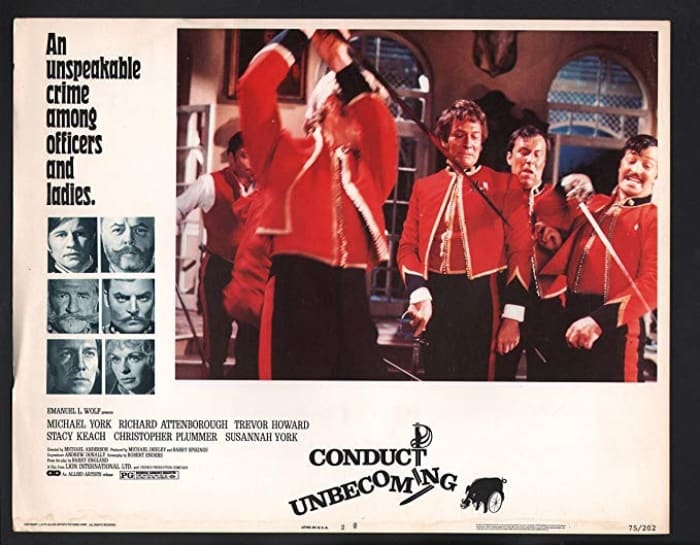
He’s joined by a fantastic cast including the already mentioned Plummer as the highly suspicious major and a handful of equally familiar faces. Richard Attenborough and Trevor Howard both play superiors of varied involvement, while Stacy Keach is terrific as the captain running the trial. His ice-cold conviction about both Drake and the man he’s defending is clear, but like My Cousin Vinny‘s (1992) Judge Chamberlain Haller, he’s a man of integrity willing to be swayed by the truth. Keach isn’t as funny as Fred Gwynne, obviously, but it’s a memorable performance all the same.
Director Michael Anderson (Murder By Phone, 1982) brings Robert Enders’ script (and Barry England’s play) to life with simplicity using sound stages and some brief blue screen work for exteriors, but the film’s power is in its performances and a commentary that skirts modern convention in some risky ways. For one, Drake’s defense is built on the premise that Scarlett is lying meaning the film’s not quite in line with today’s “believe women” mandate. To be clear, the case involves assault, not rape, but she’s still painted lightly as being somewhat promiscuous and bawdy. Drake’s attitude even sees him propose excusing his friend of some culpability due to his being inebriated that night. It’s a learning curve, though, and Drake is finding his footing as the trial proceeds across a few nights.
The true target here, beyond merely the man responsible for the actual attack, is a culture that not only allows and cultivates such behavior but that helps cover it up as well. “Did he try to put his hand on your bosom?” asks Drake of Scarlett, and there are gasps from the officers at the young man’s nerve, but these are the same people who speak of the “savages” beyond their walls and play games involving the chase and anal piercing of that stuffed boar. Their show of offense is just that, and through the trial both Drake and even Scarlett call them out for it. Her parting words see her condemning not just her assailant but all men, and it’s as contemporary a sting as you could hope.
Other elements come into play here from PTSD fueled by the trauma of war and loss to the propriety of class made evident with a command from above stating that “Gentlemen do not question the honor of other gentlemen.” That parlays into men refusing to indict each other as well, even past the point of clear wrongdoing, and it’s a straight line to realities like “the thin blue line” that afflicts modern America — we’re told there are a few bad apples within police departments, but can the others be called good if they don’t speak up from within to protect those of us on the outside?
And in conclusion…
Conduct Unbecoming is a smart, well-paced, and strongly cast drama that pairs an engrossing mystery with an indictment of men who place their supposed honor and standing above both truth and the people “beneath” their circle. The mystery and outcome both engage even as the film’s true strength, that commentary on a culture emboldened by authority, rears its powerful head. This is the good stuff, the sadly relevant stuff, and it’s currently available on Amazon Prime.
Want more sublime Prime finds? Of course you do.
 Film School Rejects https://ift.tt/36PB5r8 May 30, 2020 at 06:32PM
Комментарии
Отправить комментарий