Preserving The Mysterious Nature Of Javier Bardem's No Country For Old Men Character Was A Big Challenge
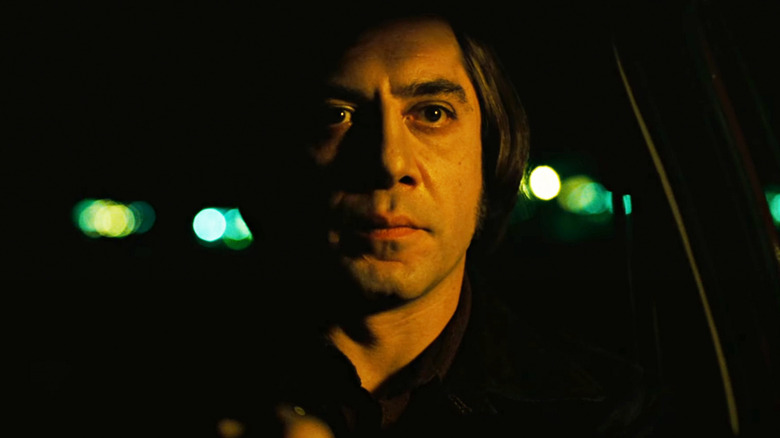
Anton Chigurh is undoubtedly one of the most memorable villains in film history. At this point, Javier Bardem's ruthless hitman has become a pop culture symbol for uncaring evil, thanks in part to "No Country For Old Men" becoming such a hit for the Coen Brothers. The directors' 2007 neo-western, based on Cormac McCarthy's novel, won four Oscars, including Best Picture, Best Director, and Best Adapted Screenplay.
But it was Bardem, who won Best Supporting Actor, who struck arguably the most resonant chord — an impressive achievement in a movie that is often considered the best of the Coens' oeuvre. His haunting portrayal of the unfeeling hitman, Chigurh, is also one of Bardem's personal best, as represented in the infamous gas station scene, which has been rewatched, analyzed, and memed to within an inch of its life since the movie debuted. In that scene and throughout, you feel how Chigurh doesn't care at all about the money he's tasked with recovering and is instead driven by an irrepressible urge to manifest his twisted form of cosmic morality by violent means.
Set in 1980 West Texas, "No Country For Old Men" provides a suitably desolate and unruly environment in which Chigurh and his bolt pistol can run riot — or rather calmly mete out his precise yet viscous form of violence. Depicting that violence while remaining faithful to McCarthy's novel was always going to be a challenge for the Coens, who had not only pivoted from their wry comedy outings to the undeniably dark "No Country," but were also faced with the task of, as Joel Coen put it, "Choos[ing] the ideas that can be expressed through a movie as opposed to through a novel." No harder was that challenge than in the case of Chigurh and his mysterious background.
Defining The Undefined
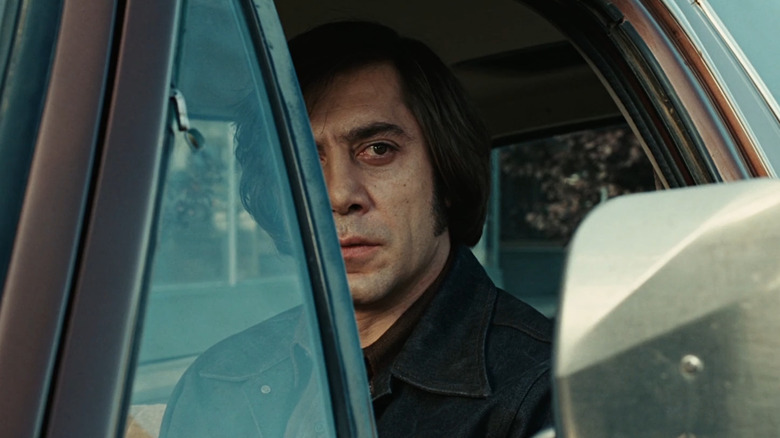
Being a Coen Brothers movie, "No Country For Old Men" investigates many grand themes, including fate, justice, and in the case of Tommy Lee Jones' aging sheriff Ed Tom Bell, the alienating effect that comes with the passing of time. And, as with many Coen projects, a study of evil — embodied by Bardem's character — forms a central part of the movie.
When it came to adapting Anton Chigurh for the screen, the brothers struggled. In the novel, McCarthy kept his descriptions intentionally vague so as to heighten the mystery surrounding the antagonist. The few descriptions offered are sparse: "He was medium height. Medium build. Looked like he was in shape. In his mid-thirties, maybe. Dark hair. Dark brown, I think. I don't know," and "He looked like anybody." Brief references to his "foreign cologne" with "a medicinal edge to it" failed to bring any real solidity to Chigurh's image, who remained "oddly untroubled" by his violent deeds "as if this were all part of his day."
How could the Coens adapt this barely-described villain for the big screen? It's an issue that the pair were keenly aware of, with Joel Coen saying:
"In the novel, the character is not described at all [...] He's very coy about it, and he makes the name sort of untraceable ethnically, he's not telling you who this guy is, what he looks like, anything of that nature. But obviously when you make a movie, you're casting an actor and bang there he is. You don't have to describe them, you can see them up there on the ... So, you've removed a lot of that, a lot of this sort of mystery of the character is now defined."
Death Brought To Life
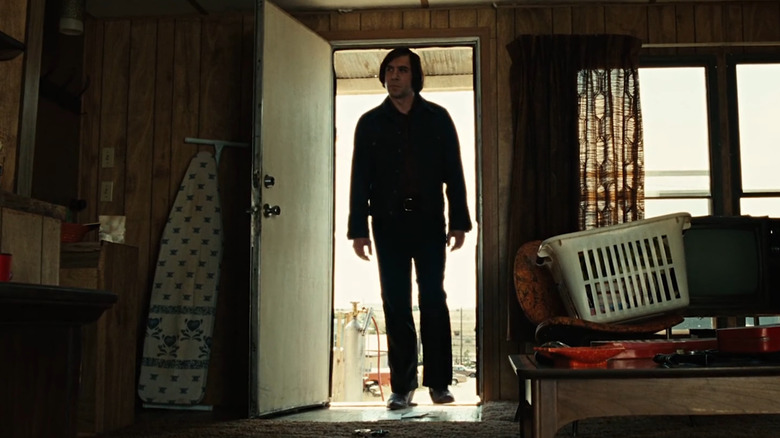
One trick the directors used was to make sure Chigurh didn't speak too much in their movie, stripping a lot of his speech from the script in order to "get back to the original sort of effect that the character has in the novel." Meanwhile, Bardem did a lot of the heavy lifting with his truly creepy performance, which was undoubtedly worthy of his eventual Oscar win. Breaking down his characters, the actor spoke about the challenge of Chigurh, noting how he would, "Follow his own ethics, no matter what" as if, "Something beyond his control or over him is telling him how to act." Still, even he was aware of the issue with translating a mysterious literary character to film, recalling how "In the book, he's not described as well. He comes, he destroys, he disappears, so you have to really understand a little bit of what's going on in your mind in order to execute those horrible actions."
Ultimately, the Coens and Bardem did about as good a job as possible bringing McCarthy's shady villain to the big screen. The character's layered bob and muted wardrobe gave him an otherworldly appearance, while his laconic aura and intimidating presence further heightened that sense of peculiar placelessness. Ultimately, Chigurh's relentless pursuit of Josh Brolin's Llewelyn Moss represented that core theme of "No Country For Old Men" in its most sinister form: you can't stop what's coming. And in that sense, despite being a more physically defined version of McCarthy's villain, Bardem's Chigurh served the exact purpose he was always supposed to, whether on the page or on the screen.
Read this next: The Coen Brothers Movies Ranked Worst To Best
The post Preserving the Mysterious Nature of Javier Bardem's No Country for Old Men Character Was a Big Challenge appeared first on /Film.
/Film https://ift.tt/Z4gPYHn December 31, 2022 at 10:00AM
Комментарии
Отправить комментарий